Marked by Choice: How One Tattoo Appointment Changed Everything
There's a version of this story where someone walks into a tattoo studio, picks something off the wall, and walks out with a butterfly on their ankle. That's a perfectly valid tattoo story. But it's not the one we're telling today.
This is about the other kind — the appointment you schedule not because you saw something cool on Instagram, but because something inside you finally said enough or now or this is who I actually am. The tattoo that doesn't just mark your skin, but marks a before and an after.
These stories are more common than you might think. And the artists who witness them? They'll tell you the energy in the room is unmistakable.
The Ritual Nobody Talks About
Ask any experienced tattoo artist about the clients who matter most to them, and almost none of them will mention the collectors with full sleeves or the regulars who book every few months. They'll mention someone who came in once, sat quietly through the whole session, and cried a little at the end — not from pain.
"There's this thing that happens sometimes," says Dani Reyes, a tattoo artist based out of Austin, Texas, who's been working for over a decade. "Someone comes in and they're nervous, but it's not the normal nervous. It's like they're about to do something that can't be undone — and they want that. They need the permanence."
Reyes describes a client — a woman in her early forties — who booked an appointment the same week she handed in her resignation from a corporate job she'd held for fifteen years. The tattoo itself was relatively small: a single line of text in her grandmother's handwriting, pulled from an old birthday card. But what it represented was enormous.
"She told me afterward that she'd been thinking about leaving that job for seven years," Reyes says. "Booking the tattoo appointment was actually the first thing she did after she made the decision. Not telling her husband. Not updating her resume. She booked the tattoo."
That sequencing — tattoo first, everything else second — isn't accidental. Psychologists who study ritual behavior have long noted that humans use symbolic acts to "lock in" decisions that feel overwhelming or reversible. The tattoo, in this context, becomes a kind of personal contract. You've put it on your body. You've committed.
When Ink Becomes Identity
For Marcus Webb, a 34-year-old graphic designer in Portland, Oregon, his first tattoo wasn't a milestone he planned. It was a response to one.
"I came out as trans at 31," he says. "And I spent a long time feeling like my body wasn't mine — like I was just borrowing it from someone I used to be. Getting tattooed was the first time I felt like I was actually choosing what my body looked like."
His first piece was a botanical design — ferns and moss, native to the Pacific Northwest — covering his left forearm. He's since added several more. But he's clear that the first one was different.
"It wasn't about the design, honestly. It was about the act. I laid there and someone put something permanent on my skin because I asked them to. That felt huge. It still feels huge."
This idea — bodily autonomy expressed through the deliberate, consensual act of tattooing — comes up repeatedly in conversations with clients who describe transformative experiences around their ink. It's not that the image itself carries all the meaning. It's the choosing. The showing up. The sitting still while something permanent happens.
The Artists Who Carry These Stories
Being on the other side of that needle comes with a weight that not every tattoo artist signs up for — but many find themselves holding it anyway.
Jordan Kwame, who runs a private studio in Atlanta, says he started paying closer attention to the emotional context of appointments after noticing a pattern he couldn't ignore.
"I had three clients in one month who all booked their first tattoos within weeks of a major loss — a divorce, a parent dying, a job ending," he says. "And none of them knew each other. But they all described the same thing: they needed to do something that was theirs. Something nobody could take back."
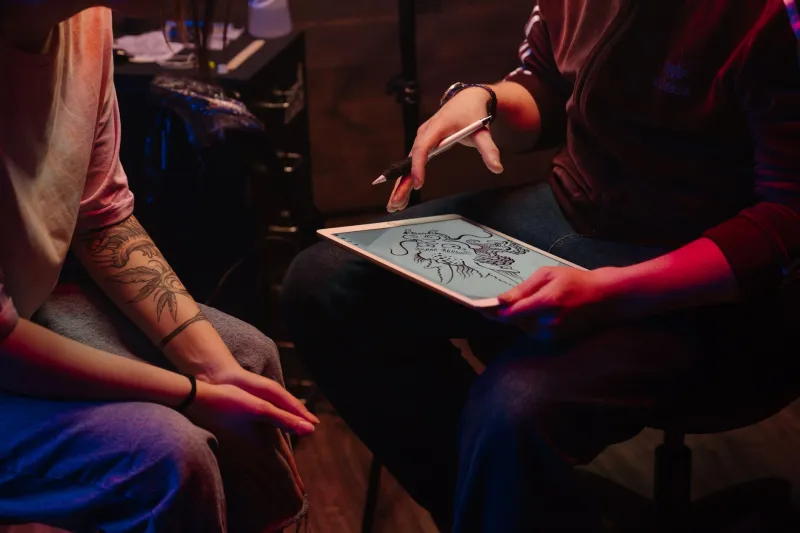
Kwame now builds extra time into consultations specifically to understand what a tattoo means to someone beyond the visual. Not in a therapeutic way, he's quick to clarify — he's a tattoo artist, not a counselor. But he's learned that understanding the emotional stakes of a piece makes him a better collaborator.
"If I know this design is connected to someone's sobriety anniversary, I'm going to approach that differently than a fun sleeve filler," he says. "The craft is the same. But my intention going in is different."
Not Just Healing — Launching
It's worth pushing back on the easy narrative here. Not every pivotal tattoo is about trauma or recovery. Sometimes ink marks a launch rather than a landing.
Simone Park, a 27-year-old chef in Chicago, got her first tattoo the day she signed the lease on her own restaurant. "I'd been working in other people's kitchens for six years," she says. "The day I signed that lease, I went straight to my artist. I got a cleaver on my wrist. Very on the nose, I know." She laughs. "But I wanted to feel it. I wanted to sit with the discomfort and come out the other side and think — okay, I can handle hard things. I'm doing this."
The tattoo as a rehearsal for courage. As a dry run for the bigger leap.
What It Means to Be Marked on Purpose
What all of these stories share isn't a particular design or a particular kind of pain. It's intentionality. The tattoos that change people's lives are almost never impulsive — they're the result of a decision that was already made, and a need to make it real in some way that a journal entry or a phone call just can't touch.
There's something ancient about that impulse. Humans have been marking their bodies to signify transitions — coming of age, mourning, belonging, becoming — for thousands of years across virtually every culture on earth. The modern American tattoo studio, with its consultation forms and aftercare instructions and curated Spotify playlists, is just the latest venue for something deeply, stubbornly human.
The needle drops. Something changes. You walk out a little different than you walked in.
Sometimes that's the whole point.