A Field Guide to Ink: Seven Styles to Know Before the Needle Touches Down
Every tattoo consultation eventually arrives at the same awkward moment: the artist asks what style you're drawn to, and you realize you don't have the vocabulary. You know what you like when you see it — you just can't name it. Consider this your cheat sheet, the one worth bookmarking before your next appointment.
American Traditional
The foundation of Western tattooing: heavy black outlines, a restrained palette of red, yellow, green, and blue, and iconic imagery — eagles, roses, pin-ups, daggers. Pioneered by artists like Norman "Sailor Jerry" Collins, it was designed to age well and read boldly. It does both, which is why fifty-year-old traditional pieces still look crisp.
Fine Line
The style that took over Instagram: delicate, single-needle work with thin, precise strokes. Florals, script, and minimalist symbols dominate. It heals soft and subtle, but the trade-off is honesty — fine lines can blur and spread slightly over decades. A skilled artist will design with that aging in mind, slightly thickening key lines.
Neo-Traditional
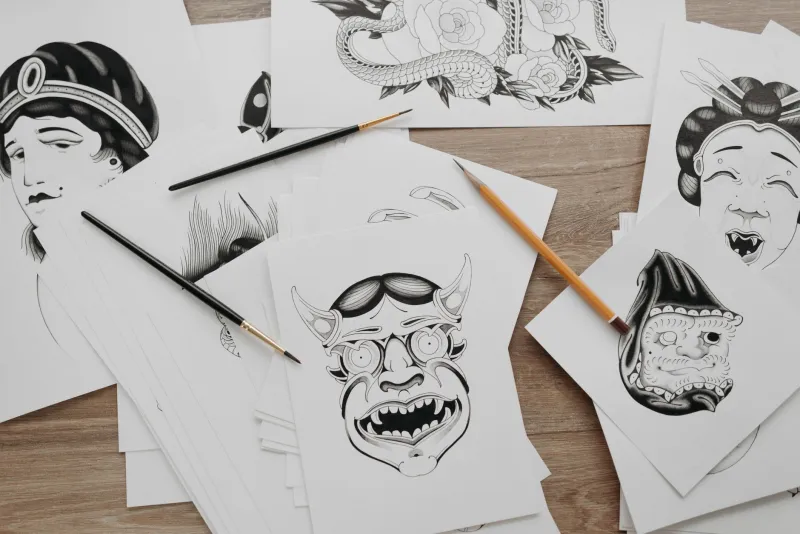
Think of it as American traditional's artistic descendant. It keeps the bold outlines but expands the color palette, adds depth and shading, and embraces more illustrative subjects — women's faces, animals, botanicals. Artists like those in the early-2000s revival scene built the bridge between old-school flash and modern illustration.
Blackwork
Everything in black ink, from bold geometric patterns to massive areas of solid saturation. Rooted in Polynesian and tribal traditions as well as graphic design, blackwork makes dramatic use of negative space. It ages exceptionally well — black is the most stable pigment — and suits people who want high contrast without color.
Realism
Portraits, wildlife, and photorealistic scenes rendered in black-and-gray or full color. Black-and-gray realism grew out of Chicano tattoo culture in California and became one of the most technically demanding styles in the industry. The caveat: realism depends on subtle value shifts, which soften as skin ages. Annual touch-ups keep it sharp.
Japanese (Irezumi-Inspired)
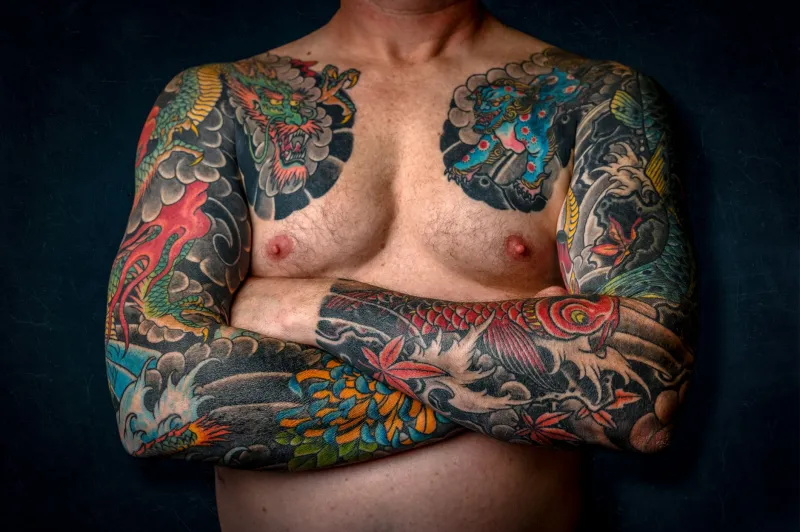
Full-body compositions built from koi, dragons, waves, chrysanthemums, and wind bars, following rules of flow developed over centuries in Japan. Traditional work follows the body's musculature rather than fighting it. In American shops, artists adapt these conventions into sleeves, backs, and bodysuits with stunning cohesion. It ages beautifully thanks to strong linework and layered color.
Ornamental
Decorative, symmetry-driven work — think henna-inspired patterns, mandalas, and jewelry-style pieces that follow the body's natural lines. Popular in placements like sternums, spines, and forearms. Line-weight variation is everything here; a great ornamental artist designs for the specific body part, not from a template.
How to Use This Knowledge
Two practical takeaways. First, style and artist aren't interchangeable — a brilliant realism specialist may be the wrong person for your traditional sleeve, so browse portfolios by style, not just by studio. Second, think in decades. Bold holds, delicate softens, black endures, and every style asks something different of your skin.
The best tattoo isn't the trendiest one. It's the one where the style, the artist, and your body all agree on the same story.