The Art of the Impossible Yes: How Great Tattoo Artists Help Clients Choose When They Can't
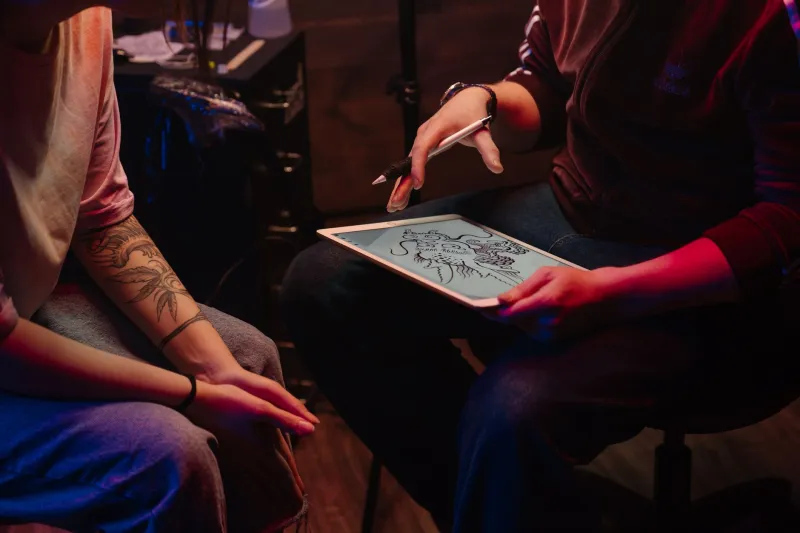
Somewhere right now, someone is sitting in a tattoo consultation with a Pinterest board containing 847 saved images, zero of which agree with each other. There are Japanese wave motifs next to minimalist line drawings next to full-color neo-traditional birds next to abstract geometric patterns. The client loves all of them. They cannot explain why. They need help.
This is not a rare situation. Ask any working tattoo artist and they'll tell you: the undecided client isn't the exception, it's practically the norm. And the way an artist handles that indecision — whether they treat it as a problem to solve or a conversation to have — often determines whether the resulting tattoo is forgettable or genuinely extraordinary.
Why Clients Can't Decide (And Why That's Actually Okay)
Before we talk about solutions, it helps to understand why this happens so often.
The internet has given tattoo enthusiasts access to literally every style of tattooing that has ever existed, from every culture, in every era, executed at every skill level. That's incredible for inspiration and genuinely terrible for decision-making. The psychology of choice overload is well-documented — the more options we have, the harder it becomes to commit to any single one. Tattoo clients aren't indecisive because they're flaky. They're indecisive because they're drowning in beautiful options.
"I actually think the 'I love everything' client is often the most interesting client," says tattoo artist Priya Nair, who works out of a studio in Denver. "They haven't narrowed themselves into a box. They're genuinely open. The challenge is helping them figure out what they're actually responding to, because it's usually not the style at all — it's the feeling."
Priya's approach starts with a question most clients don't expect: How do you want to feel when you look at this in twenty years?
"That question cuts through everything," she says. "Someone who says 'powerful' is going to end up in a different place than someone who says 'peaceful' or 'connected to something larger than myself.' The style becomes secondary once you know the emotional target."
Breaking Down the Board
For artists who work with visually scattered clients, the Pinterest board (or Instagram saves, or reference folder) is both the problem and the solution. The images are clues — the client just doesn't know how to read them yet.
Tattoo artist James Holloway, based in Nashville, has developed what he calls a "stripping exercise" for consultations with overwhelmed clients. "I go through their references and I ask them to separate them into two piles: things that make their chest feel open and things that make their chest feel tight. Not 'like' and 'don't like.' Open and tight. It's a body response, not an intellectual one."
The results, James says, are almost always clarifying. "Someone will put twenty images in the 'open' pile and they're all doing the same thing — they're all organic, flowing, nature-based. And they've got ten images in the 'tight' pile that are all rigid geometry. They came in thinking they liked both. Their body told me the truth."
Priya uses a similar but more conversational approach. She asks clients to talk through their references as if they're describing them to someone who can't see them. "When you have to use words, you reveal what you actually noticed. Someone who describes a tattoo by talking about how the lines feel like they're moving — that person is responding to energy and flow. Someone who describes the precision of the symmetry — that's a different person with a different need."
When Styles Actually Collide
Sometimes the challenge isn't helping a client find their true preference — it's synthesizing genuinely competing aesthetics into something coherent. This is where the real craft comes in.
Sophia Ramos, who tattoos in Miami and specializes in what she calls "fusion work," has built a significant following precisely because of her ability to blend styles that shouldn't, technically, work together.
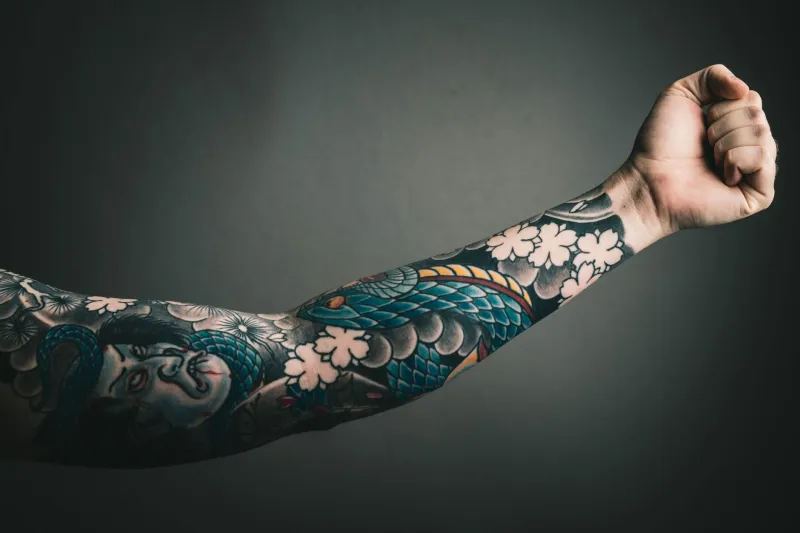
"Clients come to me all the time wanting Japanese traditional elements with a watercolor treatment," she says. "On paper, those two things fight each other. Japanese traditional is bold lines, flat color, structured composition. Watercolor is loose, bleedy, anti-structure. But they can coexist if you understand what each one is actually doing."
Sophia's approach is to identify the load-bearing elements of each style — the things that make it recognizable — and protect those while letting the peripheral details negotiate. "The bold outline is what makes Japanese traditional Japanese traditional. Keep that. Let the color field inside it breathe and bleed like watercolor. You've honored both."
Not every combination is workable, though, and the best artists know when to push back.
The Productive No
James Holloway is direct about this. "Sometimes indecision isn't about having too many good options. Sometimes it's about wanting something that doesn't exist yet, and the client needs someone to tell them that honestly rather than just trying to mash things together and produce a mess."
He describes a consultation where a client wanted a photorealistic portrait of their dog executed in a traditional American style with blackwork geometric framing. "Those three things are each a full commitment. They're not decorative choices, they're fundamental approaches to how you make a tattoo. You can't do all three at once and have any of them land."
James spent an hour with that client breaking down what each style actually required, what it would look like if done well, and what would be sacrificed by trying to combine them. "By the end of it, the client chose the portrait. Clean, realistic, beautiful. They thanked me six months later and said it was exactly right. The other two ideas would have cluttered it."
Priya frames the pushback as part of the service. "My job isn't to give people what they say they want. My job is to give them what they actually need, which is sometimes different. I'm not being difficult when I challenge an idea. I'm being honest about what I can make great versus what I can only make okay."
The Conversation Is the Design
What becomes clear talking to artists who excel with indecisive clients is that the consultation itself is creative work. The design doesn't start when the artist picks up a pencil — it starts when the client starts talking.
Sophia puts it plainly: "The best tattoos I've ever made came out of the longest conversations. Not because the client was difficult, but because we had time to get to the real thing. The thing underneath all the references. The image that was trying to exist before they even knew what it looked like."
That's the job, in the end. Not just executing a design, but finding it — and sometimes that means helping a client sit with their own beautiful, chaotic, impossible indecision long enough for the answer to surface on its own.