No Space Left: What Happens When Your Body Is Full and You Still Love Tattoos
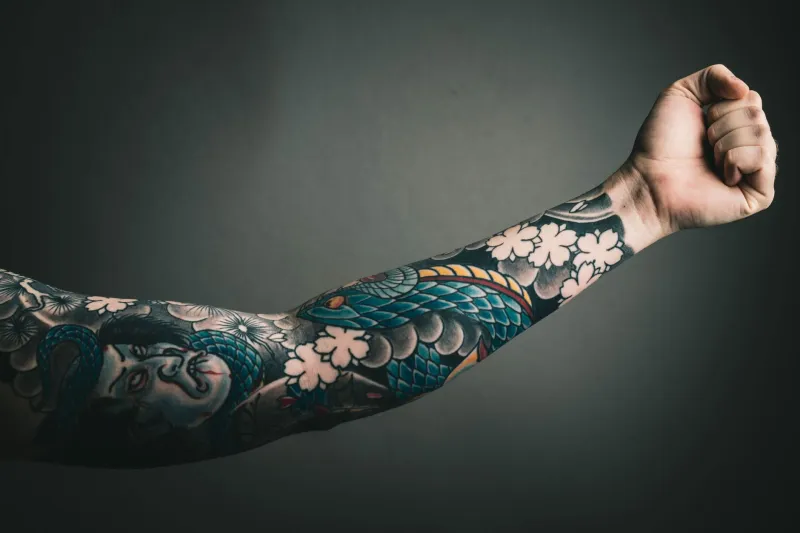
For most tattoo collectors, there's a fantasy version of "full coverage" that exists somewhere in the future — a distant horizon of completed sleeves and connected back pieces that feels aspirational rather than imminent. And then one day, usually gradually and then suddenly, you look in the mirror and realize: you're almost there. Or you're there. And you still want more.
This is the tattoo collector's dilemma, and it's more emotionally complicated than it sounds.
"People don't talk about this enough," says Priya, a 38-year-old project manager in Portland who started tattooing at nineteen and now has coverage on both arms, her chest, back, both thighs, and her calves. "You spend fifteen years building something and then you're standing there thinking — okay, now what? And there's grief in that, weirdly. Real grief."
The question of what to do when you're running out of canvas isn't just logistical. It touches on identity, memory, loss, and the psychology of collecting itself. And the answers people arrive at are as individual as the work covering their skin.
The Inventory Problem
Before you can figure out where to go next, you have to take stock of where you've been. For heavily tattooed collectors, that means confronting a body that holds years of decisions — some brilliant, some regrettable, some simply dated.
There's always the early work. The pieces from the first years of collecting that seemed great at the time and now sit awkwardly next to more sophisticated, more intentional work. For many collectors, "running out of space" becomes a moment of reckoning with those earlier pieces.
That's where cover-up and rework conversations come in. But those aren't simple either. "There's a real emotional weight to covering an old tattoo, even a bad one," says Chicago-based tattoo artist Devon Park, who specializes in complex reworks and has navigated these conversations with clients for years. "That old piece was you at a certain age, making a certain choice. Covering it isn't neutral. It's a decision that has to feel right, not just look right."
Devon says that when long-term collectors come to him about running out of space, the conversation almost always goes two directions simultaneously: the practical (where can we realistically fit something?) and the emotional (what do you actually want your body to say at this point in your life?). "Those two conversations are inseparable," he says.
Going Smaller, Going Deeper
One popular solution for collectors hitting their limits is micro-work — tiny, precise pieces that can nestle into gaps between larger designs or occupy small areas that previously felt too awkward to fill. The growth of fine-line and micro-realism as dominant styles over the past decade has made this more viable than ever.
But not everyone loves the solution. "I have a heavily traditional-style collection," says Marcus, a 44-year-old musician in Nashville. "Throwing a bunch of tiny fine-line pieces in the gaps would look insane. It's like putting Post-it notes in a mural."
For collectors with cohesive styles, the gaps-and-micros approach can feel like a compromise that undermines the visual integrity of the whole. For others, it's a genuinely creative expansion — a chance to add detail and dimension to a collection without disrupting what's already there.
Style compatibility is something artists think about seriously. "I'll turn down a gap-fill request if I don't think it serves the collection," says Yolanda, a tattoo artist in Austin who works primarily with long-term clients. "I'm not just filling a square inch of skin. I'm participating in something someone has been building for years. That requires respect for the whole."
The Territories People Forget
For many collectors, "running out of space" is actually "running out of space in the places I'm comfortable with" — which is a meaningfully different problem.
The areas people tend to leave untouched the longest: the hands and fingers (professional concerns, faster fading, social visibility), the neck (stigma that hasn't fully dissolved even as tattoo culture has mainstreamed), the face (a different category entirely), the feet (painful, prone to fading), the ribs (notoriously brutal), and certain intimate areas that require a different kind of commitment.
For some collectors, hitting their comfort-zone limit becomes the moment they finally decide to expand those limits. Priya got her first hand tattoos at 36, after years of holding off. "I work in tech, not finance. The world has changed. And I finally just decided the piece I wanted mattered more than the hypothetical professional consequences."
For others, those limits are real and worth respecting — and the recognition that the collection is genuinely complete is its own kind of milestone.
When 'Complete' Isn't a Failure
Perhaps the most psychologically interesting shift that happens for long-term collectors is the move from accumulation to curation. At some point, the question stops being "what do I add next?" and starts being "what does this collection mean as a whole?"
"I spent twenty years adding," says Theresa, a 52-year-old teacher in Boston who is fully sleeved on both arms and has extensive torso work. "At some point I realized I was done. Not because I'd run out of room exactly, but because the collection felt finished. Like a book that had found its ending."
That shift — from collector to curator — is something Devon Park sees regularly. "The clients I respect most are the ones who can look at what they've built and say, 'This is it. This is the thing.' That takes a kind of self-knowledge that's actually pretty rare."
It also requires letting go of the identity of someone who is always in process, always becoming, always adding. For people who have organized a significant part of their self-concept around being a tattoo collector, that's not a small thing.
"I still love tattoos," Priya says. "I love going to conventions, following artists, talking about this stuff. I just don't need to keep adding to what I have. What I have is enough." She pauses. "It took me a while to feel okay saying that."
Maybe that's the real final stage of collecting: not the last piece of ink, but the moment you realize the story your skin is telling is already complete.