Try Before You Commit: How Temporary Tattoos Are Quietly Changing the Way Americans Go Permanent
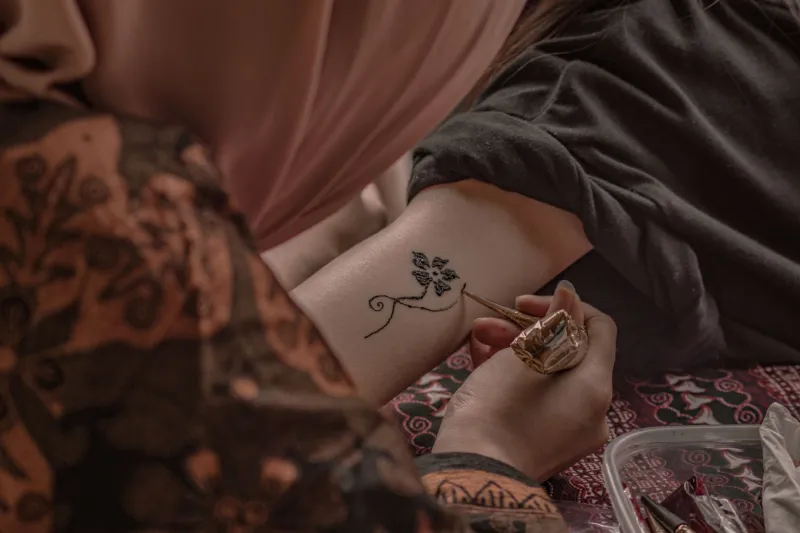
There's a moment that tattoo artist Dani Reyes from Austin, Texas describes as "the lightbulb session." A client comes in wanting a semi-permanent jagua design on their forearm — something that'll fade in two to three weeks. They leave happy. Then, about ten days later, they call back. Not to ask how the ink is holding up, but to ask how soon they can book a permanent appointment for the exact same design.
"It happens more than people realize," Dani says. "They think they're just testing the waters. And then they look down at their arm every single day and they're like — yeah, that's mine. That belongs there."
This is the new gateway to permanent body art, and it's way more intentional than you might think.
From Party Favor to Legitimate Preview
Temporary tattoo culture in America has had a serious glow-up. We're not talking about the drugstore shimmer transfers you stuck on your ankle before prom. The landscape now includes:
- Jagua gel, a fruit-based dye that produces deep blue-black designs lasting two to three weeks
- Henna (both natural and synthetic varieties), a staple in South Asian and Middle Eastern traditions now widely embraced in the US
- Semi-permanent tattoos applied by licensed artists using specialized inks that fade over six to eighteen months
- Inkbox-style at-home kits that use freehand application and skin-staining formulas
Each of these serves a different purpose, but they share one increasingly common use case: giving people a real-world preview of what permanent ink might look like on their actual body, in their actual life.
Portland-based artist Marcus Webb, who offers what he calls "commitment consultations" — a session where clients wear a temporary version of their intended design for at least two weeks before booking — says the practice has transformed how his clients approach permanent work.
"Most people underestimate how much a tattoo changes depending on placement, your skin tone, how it moves with your body," Marcus explains. "A temporary run lets them feel all of that before we make it forever. And honestly? It makes my job easier because they come in so much more confident."
Why the "Practice Round" Actually Works
The psychology here is fascinating. When something is temporary, we interact with it differently. We look at it more. We notice how other people react. We pay attention to whether we reach for long sleeves on certain days or whether we find ourselves showing it off at every opportunity.
Chicago-based therapist and self-described "heavily tattooed person" Dr. Simone Okafor puts it plainly: "Permanence creates anxiety. Remove the permanence, and suddenly people can actually feel their instincts about something rather than overthinking it."
That's exactly what happened to Meredith Cruz, a 29-year-old teacher from Nashville. She'd been sketching the same botanical illustration in her journal for three years — a sprig of rosemary with tiny roots dangling below it. She loved it in theory but couldn't pull the trigger on booking an appointment.
"I finally got a jagua version done at a market stall," she says. "And within four days I knew. I kept catching myself looking at it. I'd forget it was there and then see it and feel happy. That's when I knew it wasn't just a phase."
The rosemary sprig is now permanently on her inner wrist. She's already planning her next piece.
When the Preview Changes Your Mind (And That's Okay)
Of course, the whole point of a test drive is that sometimes you decide not to buy the car. And artists who work in the temporary space say that outcome is equally valuable.
"I've had people come back to me and say, 'I thought I wanted a half-sleeve floral piece on my forearm and now I realize I want something smaller on my shoulder blade,'" says Keiko Tanaka, a Los Angeles-based henna and jagua artist who works primarily with clients navigating permanent tattoo decisions. "That's not a failure. That's the system working exactly like it's supposed to."
Keiko estimates that roughly a third of her clients end up significantly changing their intended permanent design after going through a temporary preview. Another third go through with their original plan, but with far more conviction. And the remaining third decide they don't actually want a permanent tattoo at all — and are relieved to have figured that out before the needle dropped.
"Honestly, that last group thanks me the most," she laughs.
The Artists Who've Made It a Business Model
The temporary-to-permanent pipeline has gotten organized enough that some studios are building formal programs around it. Ink Ritual, a Brooklyn shop, offers a "Blueprint Package" where clients pay for a temporary design consultation and application, with that cost credited toward their permanent booking if they decide to move forward within ninety days.
In Denver, a collective of artists called Soft Proof Studio has built their entire brand around the concept — offering temporary mock-ups of custom designs before any permanent work begins. Their waitlist is currently four months long.
The market is clearly responding. According to a 2023 survey by the Professional Beauty Association, interest in semi-permanent and temporary tattoo services has grown by over 40% since 2020, with the strongest growth among adults aged 25 to 40 — exactly the demographic most actively seeking permanent work.
So What Stays Forever?
Here's the thing nobody expected: some of the most meaningful permanent tattoos people are getting right now started as something they thought was just a trial. The design they wore for two weeks and couldn't stop thinking about. The placement they were unsure of until they lived with it.
For Meredith, the rosemary sprig that started as a market-stall impulse is now the anchor of what she plans to be a full botanical sleeve — all designed and tested piece by piece before any of it becomes permanent.
"I used to think people who got tattoos were just impulsive," she admits. "Now I think some of them are actually the most deliberate people I know."
And maybe that's the real shift happening here. Temporary ink isn't the opposite of permanence. For a lot of people, it's the path to it — taken slowly, thoughtfully, and with a whole lot more certainty on the other side.