Built to Last: What Twenty Summers Actually Do to Your Ink

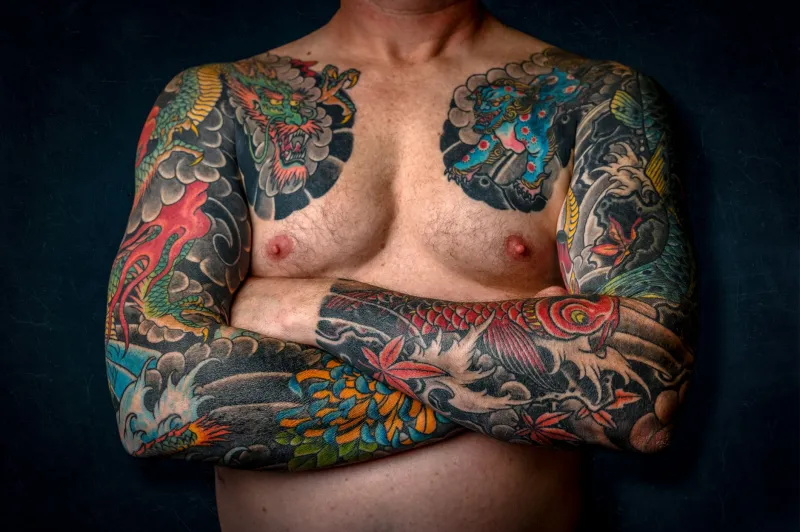
Photo: sunlit tattooed arm close-up sunscreen, via www.ilr.cornell.edu
The first time I saw a two-decade-old tattoo up close, it was on a guy named Marcus in a Phoenix shop. The piece — a swallow on his forearm, done in 2004 — had gone the color of weak tea. The lines hadn’t disappeared. They’d just softened, like a photograph left on a dashboard. ‘That’s the sun,’ his artist said. ‘It always wins.’
But in 2026, artists are fighting back with design choices, placement strategy, and aftercare that treats UV like the long-term adversary it is. The goal isn’t to beat the sun. It’s to build ink that ages with some dignity.
What UV actually does under the skin
Tattoo pigment lives in the dermis, below the epidermis. UV radiation doesn’t just bleach color. It generates free radicals that break down pigment particles and degrade the collagen scaffolding around them. Your immune system, meanwhile, keeps chewing on ink particles it can’t fully clear. Over years, that combination causes fading, color shift, and the soft blur that makes old tattoos look like they’re behind frosted glass.
Black ink is the most stable, but it still fades to blue-gray. Reds are notorious for shifting brown; yellows and oranges can vanish; blues and greens tend to hold better. ‘The color wheel is not equal under the sun,’ says Dr. Elena Park, a dermatologist in San Diego who works with tattooed patients. ‘Red pigment is a smaller molecule and more vulnerable to photodegradation. That’s why a red rose from 2010 might look like a bruise now.’
The placement penalty
Where you put ink matters more than most clients realize. Forearms, ankles, shoulders, neck, hands — these are high-UV zones. Ribs, back, thighs, and upper arms spend more time under clothing. Artists in sunny states have started saying the quiet part out loud: if you want a fine-line piece on your hand, understand it’s a mayfly.
‘I tell clients in Florida that a delicate watercolor piece on the ankle is a five-year tattoo, not a fifty-year tattoo,’ says Maya Ruiz, an artist in Tampa. ‘If they want it to last, we go bolder or we move it.’
The new-look flash: designing for the long haul
Future-proofing a tattoo is partly about ink chemistry — newer pigment dispersions can be more lightfast, though ‘new’ doesn’t automatically mean ‘better’ — and partly about design. Bold outlines, high contrast, negative space, and fewer hair-thin details age more gracefully. Fine-line work is beautiful, but it has a shorter shelf life. ‘Aging is a design constraint,’ Ruiz says. ‘If you ignore it, it will humble you.’
In 2026, more artists are offering ‘legacy’ consultations: a conversation about how the piece will look in ten, twenty, thirty years. They ask clients to bring photos of aged tattoos they admire. They talk about blur. They may recommend a larger piece with simpler shapes over a small, intricate one.
Aftercare that actually matters
Once healed, daily SPF 30 to 50 on exposed tattoos is the single best defense. UPF clothing helps. Tanning beds are basically a fade accelerator. Moisturize, avoid harsh exfoliants, and don’t panic when a touch-up becomes necessary — it’s maintenance, not failure.
Park recommends treating tattooed skin like any sun-sensitive skin: ‘UV damage is cumulative. Every beach day adds up. The tattoo you love in 2026 is competing with every summer that follows.’
The 2046 test
When you’re planning a piece, ask your artist: how will this look in twenty years? If they can’t answer, find someone who can. The best tattoo artists aren’t just drawing for today’s camera roll. They’re drawing for the long, bright, unforgiving future.