Same Skin, Different Person: How Your Tattoo Choices Shift From Your Twenties to Your Forties
There's a tattoo artist in Austin named Renata Solís who keeps a running mental archive of her long-term clients. Not just their skin tones and healing patterns — she remembers what they wanted, and more importantly, why they wanted it. She tattooed a woman named Claire at 24 with a delicate crescent moon on her collarbone. Twelve years later, Claire came back for a sprawling botanical sleeve. Same person. Completely different conversation.
"At 24, Claire knew what she liked," Renata says. "At 36, she knew who she was."
That distinction — between taste and identity — is maybe the clearest way to understand how our tattoo choices evolve as we age. It's not just about getting bolder or more refined. It's about what we're actually trying to say, and whether we've figured out how to say it yet.
The Twenties: Staking a Claim
For most people, early tattoos are acts of declaration. You're carving out space in the world, announcing your aesthetic, your affiliations, your refusal to be ordinary. The imagery tends to be immediate and emotionally charged — a lyric from the album that got you through a breakup, a symbol from a subculture you've claimed as home, a memorial piece for a loss that still feels fresh and enormous.
There's nothing wrong with any of that. Urgency is its own kind of beauty.
But artists who've been in the business long enough to tattoo clients across multiple life stages notice a pattern: twenty-somethings tend to bring in reference images. They know what they want it to look like before they know what they want it to mean. The visual comes first, and the meaning gets layered on after.
"A lot of younger clients come in with a Pinterest board," says Marcus Webb, a Philadelphia-based artist with 18 years of experience. "And that's totally fine — that's part of the process. But when I ask them what the piece means to them, sometimes there's a pause. Like they haven't fully connected the image to the feeling yet."
That gap isn't a flaw. It's developmental. You're still assembling the vocabulary.
The Thirties: Editing Yourself
Something shifts in the middle years. People start showing up to consultations with fewer reference photos and more words. They'll describe a feeling, a relationship, a chapter they're trying to close or commemorate. The image becomes secondary to the concept.
This is also the era of the cover-up and the rework. Not because people hate their early tattoos, necessarily, but because the story has changed. That tribal band from 2004 isn't offensive so much as it's simply wrong now — wrong for who you've become, wrong for what you want your skin to communicate.
Renata sees this constantly. "The thirties are when people start editing," she says. "They've lived enough to know what they actually value. And sometimes the tattoos they got at 22 don't make that list anymore."
The design choices in this decade tend toward the intentional and the personal. Less trend-chasing, more bespoke. A lot of people in their thirties are also thinking about placement differently — they're in careers, they're navigating professional spaces, and the visibility of their ink becomes a more conscious calculation rather than an afterthought.
The Forties: Earned Symbolism
By the time clients hit their forties, something remarkable happens: they stop apologizing. Not just for their tattoos, but for themselves. And that confidence radiates directly into their design choices.
Marcus describes a client in his mid-forties who came in wanting a large back piece — something he'd been thinking about for over a decade but kept putting off. "He said he kept waiting until he was sure. And I asked him, sure of what? And he said, 'Sure that I deserved it.'" Marcus shakes his head at that. "That broke my heart a little. But also, when we finally did the piece, it was the most meaningful session I've had in years. He knew exactly what he wanted and why. There was no second-guessing."
Fort-something clients tend to come in with a kind of clarity that younger clients are still building toward. They've lost people. They've rebuilt relationships. They've survived things. And their tattoos reflect that weight — not in a grim way, but in a way that feels genuinely earned.
The imagery often gets quieter, too. Less screaming symbolism, more understated meaning. A single flower. A coordinate. A word in a parent's handwriting. The older the client, the more likely they are to choose something that would mean nothing to a stranger and everything to them.
Do We Grow Into Our Tattoos — Or Out of Them?
This is the question that keeps tattoo artists up at night, philosophically speaking. And the honest answer is: both.
Some tattoos age with you in the best possible way. The memorial piece for your grandmother becomes more precious as time passes. The bold geometric you got at 23 turns out to be genuinely timeless. The ink that felt impulsive at the time turns out to have been instinctively right.
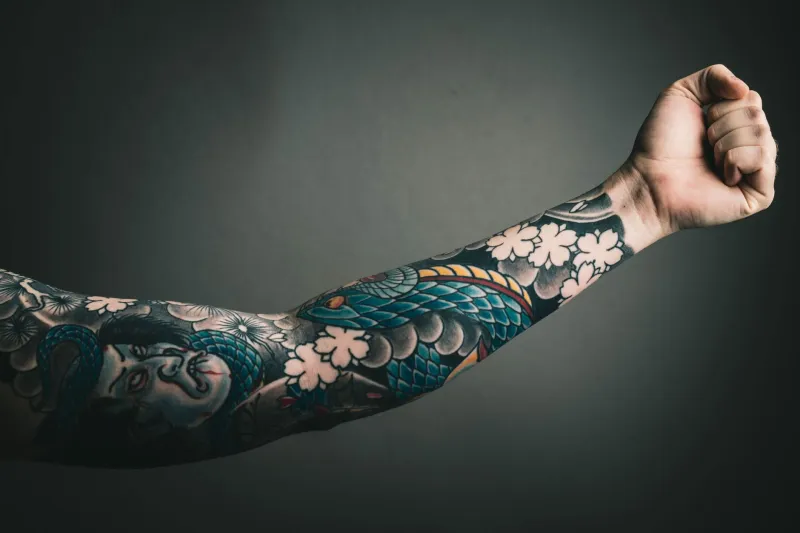
Other tattoos become artifacts — not regrets, exactly, but evidence of a self you've moved past. And that's okay, too. There's something almost archaeological about a sleeve that spans fifteen years. Each piece is a timestamp. Each style shift is a chapter.
Renata thinks the most interesting clients are the ones who refuse to erase. "I have clients who could easily cover up their early work, but they don't want to. They want the whole story visible. That takes a kind of courage, honestly — to walk around wearing every version of yourself."
What Artists Learn From Watching You Change
If there's a gift in tattooing the same person across decades, it's this: artists get to witness growth in a way that's almost unparalleled. They see you at your most vulnerable, your most certain, your most confused. They watch you become someone.
And what the best artists will tell you is that there's no right age to get tattooed, no superior philosophy, no version of you that makes better decisions than the others. The 25-year-old who wants a quote from a band that defined their adolescence isn't less valid than the 45-year-old who wants a minimalist piece commemorating sobriety. Both are telling the truth about who they are right now.
The skin doesn't judge. It just holds the record.
Maybe that's the whole point — not to get the perfect tattoo, but to keep getting honest ones. To let your body be a living document of every person you've been brave enough to become.
And if some of those chapters don't quite fit anymore? Well. That's what good artists are for.