The Algorithm Ate the Flash Wall: Life After Tattooing Went Viral
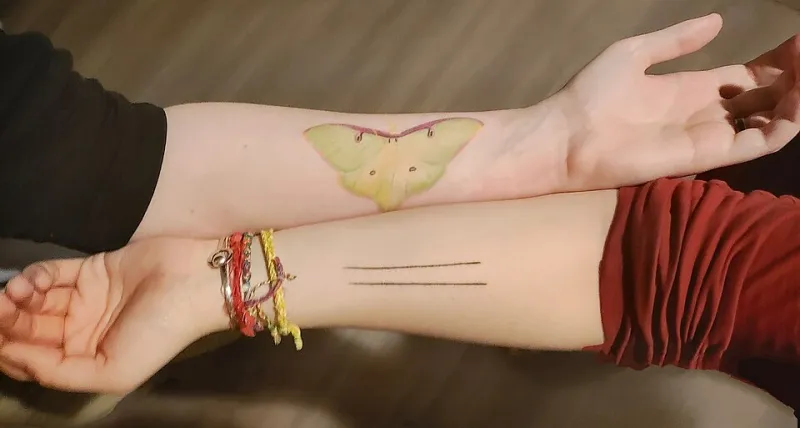
Photo: "Growth": Pines and Cassandra Gatelein "Up the Ladder to the Roof": Lloyd and unknown tattoo artist Photograph: Tamzin Hadasa Kelly, Public domain, via Wikimedia Commons
A Tattoo Sized for Your Feed
There's a particular irony in the fact that the most popular tattoos of the Instagram era are barely visible in person. Fine line florals. Micro-realism the size of a quarter. Delicate script that photographs beautifully at arm's length and reads as a smudge from across the room.
These designs weren't invented on social media, but they were optimized there. A tiny, high-contrast, minimalist piece is a perfect Instagram object: legible in a square crop, flattering on every skin tone in a carousel, easy to replicate at scale. The algorithm didn't just change how artists market their work. It changed what work gets made.
The View From the Chair
Ask working artists about this shift and you'll get a complicated answer — usually starting with gratitude.
"Instagram is the reason I have a career," says one Portland-based fine line artist who books out eight months in advance. "I came up posting my drawings. There's no version of my life where a walk-in shop on a side street finds me that audience."
But the same artists describe a quiet tug-of-war between what the feed rewards and what the craft demands. Big traditional pieces — back pieces, sleeves, the work that fills a portfolio over decades — don't perform the same way online. They're hard to photograph, slow to finish, and impossible to batch into viral content. Clients arrive with screenshots of the same twelve designs everyone else is getting, asking for a tattoo that was never really theirs.
"I turned away more single-needle botanical work last year than I've ever done," one artist told us. "Not because it's bad work. Because I do it all day, and when I draw something of my own, nobody sees it. The feed only shows them the thing I've already done a hundred times."
Flattening or Elevation?
The pessimist's case is straightforward: the algorithm homogenizes. Regional style — the thing that made American tattooing interesting, the difference between a Philadelphia shop and a Los Angeles one — erodes when every client in every city wants the same aesthetic. Artists become content producers, and tattoos become merchandise.
The optimist's case is just as real. Social media demolished the gatekeeping that once kept tattooing a closed club. Artists in small towns build national followings. Black, queer, and disabled artists who were shut out of traditional shops found clients directly. Technical standards rose across the board because everyone's work is now publicly comparable. And plenty of clients get their first tattoo — a gateway piece — because a tiny design felt approachable. Some of them come back for the sleeves.
What Lasts
Here's what the artists we spoke with keep returning to: skin doesn't have an algorithm. A tattoo ages on a body, not a grid. The fine line piece that photographs perfectly at week one may blur by year ten; the bold traditional work that looks dated in a feed still reads clean at seventy.
The healthiest artists seem to be the ones treating Instagram as a storefront, not a compass. They post what books the clients, then spend the margins of their career on the work that made them pick up a machine in the first place. The trend pays the rent. The craft builds the legacy.
The flash wall used to tell you what a shop believed in. The feed tells you what's selling. The best tattooing in America right now is happening in the space between the two.